
You were in an accident. The repairs are finished, the paint is glistening, and your car looks as good as new. You might think you’ve been “made whole” by the insurance company.
Think again.
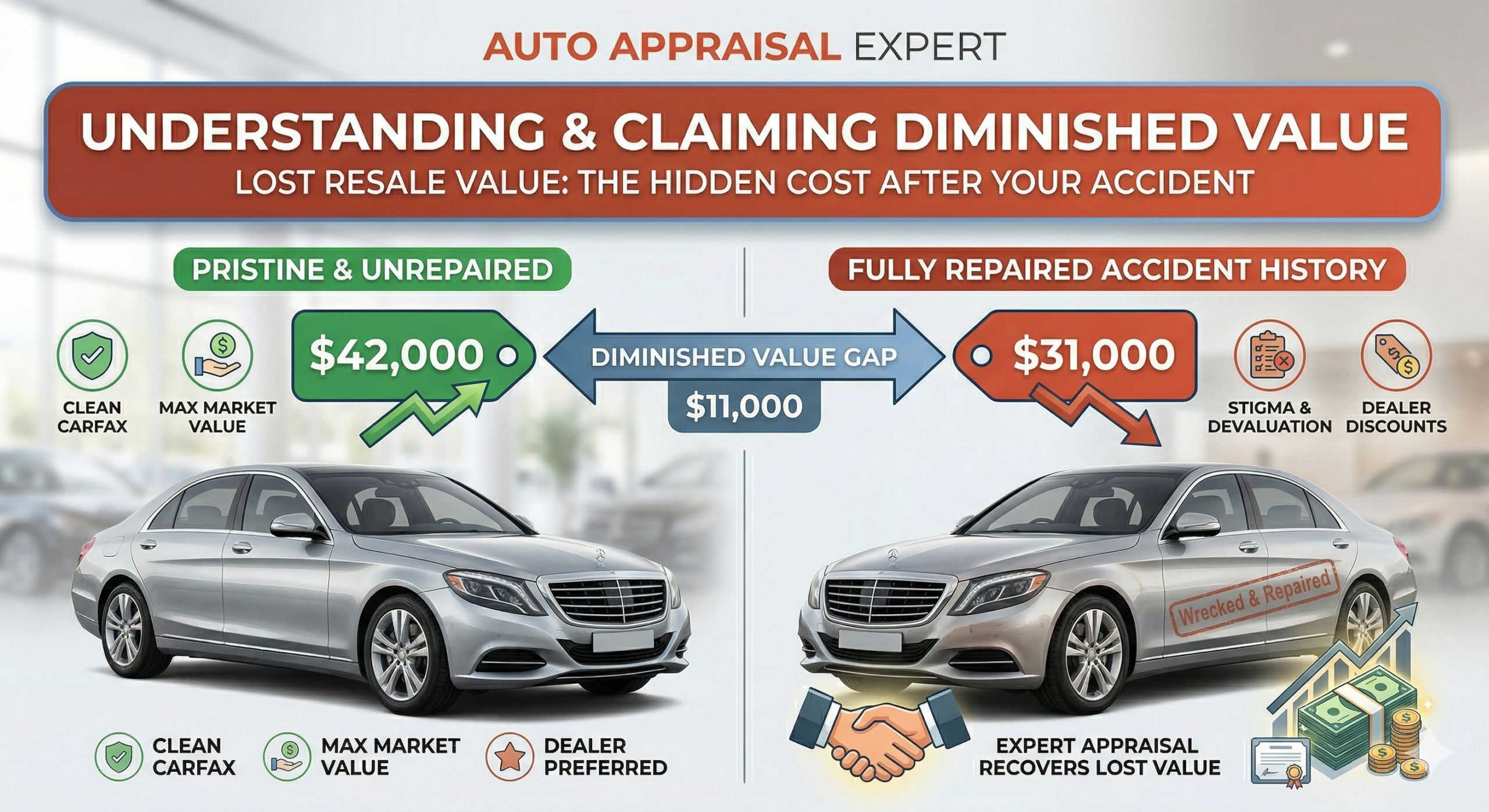
Even if a master technician restores your vehicle to factory specifications, its market value has likely plummeted. This loss in value—caused simply by the existence of an accident on the vehicle’s history report (like CARFAX)—is known as Diminished Value.
At Auto Appraisal Expert, we help vehicle owners recover this “hidden” financial loss. In this guide, we will explore what diminished value is, the different types you can claim, and how to successfully file a claim against an insurance company.
1. What Exactly is Diminished Value?
Diminished Value (DV) is the difference in a vehicle’s market value before an accident and its market value after it has been fully repaired.
Imagine two identical 2023 BMW 3-Series cars sitting on a dealer lot. They have the same mileage, the same features, and the same price. However, one has a clean history report, and the other has a $15,000 repair record for front-end damage.
Which one would you buy? Naturally, you’d pick the one without the accident history. If you were forced to buy the repaired one, you’d demand a significant discount. That discount is the Diminished Value.
2. The Three Types of Diminished Value
Not all diminished value is the same. In the eyes of the law and insurance companies, it is categorized into three distinct types:
Inherent Diminished Value
This is the most common form. It assumes the car was repaired to the best possible standard, but because it now has an accident history, it is worth less. Consumers are wary of “wrecked” cars, and dealerships will offer less for them on a trade-in.
Repair-Related Diminished Value
This occurs when the repairs are sub-par. If the paint doesn’t match perfectly, the panels are misaligned, or the frame wasn’t straightened correctly, the car loses even more value due to the poor quality of the work.
Immediate Diminished Value
This represents the difference in value immediately after the damage occurs but before it is repaired. This is rarely used in insurance claims but is a factor in certain legal contexts.
3. Are You Eligible to File a Claim?
Most people don’t realize they are entitled to a check for diminished value. However, there are usually four main “rules” for eligibility:
- You are not at fault: In most states, you cannot claim diminished value against your own insurance policy if you caused the accident (this is a “First-Party Claim”). You must file against the at-fault driver’s insurance (“Third-Party Claim”).
- The Statute of Limitations: You generally have 2 to 6 years (depending on your state) from the date of the accident to file a claim.
- The Car is Not Totaled: If your car is a total loss, you aren’t seeking diminished value; you are seeking the full Actual Cash Value (ACV).
- No Prior Major Damage: If your car had three previous accidents, the “new” diminished value from a fourth accident is much harder to prove.
4. How Insurance Companies Try to Avoid Paying
Insurance adjusters are trained to discourage diminished value claims. Here are the common tactics they use:
- The “17c Formula”: Many insurers use a flawed mathematical formula (born from a Georgia court case) called 17c. This formula automatically caps the loss at 10% of the car’s value and applies arbitrary “mileage” and “damage” multipliers that drastically reduce your payout. This formula is not law in most states and should always be challenged.
- The “It Looks Fine” Defense: The adjuster will argue that since the car is repaired, there is no loss. This ignores the reality of the retail market and CARFAX reports.
- The “Wait and See” Tactic: They may tell you that you haven’t “realized” the loss because you haven’t sold the car yet. This is legally incorrect; the loss occurs the moment the metal is bent.
5. How to Calculate and Prove Your Loss
To win a diminished value claim, you need more than an “online calculator” result. You need a Certified Diminished Value Appraisal.
A professional appraisal involves:
- Market Analysis: Comparing your vehicle to actual sales data of “clean” vs. “accident” vehicles.
- Dealer Quotes: Obtaining statements from local dealerships indicating what they would have offered for your car before the wreck vs. what they would offer now.
- Expert Inspection: A physical or comprehensive digital inspection to verify the quality of repairs and the severity of the structural impact.
6. The Step-by-Step Claim Process
Step 1: Wait for Repairs to be Completed
You cannot finalize a diminished value claim until the final repair bill is tallied. The severity of the repair is a major factor in the calculation.
Step 2: Establish the At-Fault Party
Ensure the other driver’s insurance has accepted 100% liability. If liability is split (e.g., 80/20), your DV payout will be reduced by your percentage of fault.
Step 3: Hire an Independent Appraiser
Do not rely on the insurance company to tell you what your car is worth. Contact Auto Appraisal Expert. We provide a USPAP-compliant report that serves as a legal demand for payment.
Step 4: Submit the Demand Package
Send your professional appraisal report to the insurance adjuster. Be firm. State that you are aware of your rights and that the report represents the actual market loss.
Step 5: Negotiate
The adjuster will likely come back with a “low-ball” counter-offer. Your appraiser can help you navigate these negotiations or, if necessary, you can take the claim to Small Claims Court, where a certified appraisal is your best piece of evidence.
7. Why High-End and New Cars Suffer Most
While any relatively new car (less than 7–10 years old) can have a diminished value claim, two categories suffer the most:
- Luxury & Exotic Cars: A “minor” $5,000 repair on a Ferrari or Lamborghini can result in a $50,000 drop in resale value. Specialist buyers in this market will not touch a car with a “hit” on the history report.
- Electric Vehicles (EVs): Since EVs like Teslas rely heavily on structural battery packs and complex sensors, even a small collision can create massive “stigma” regarding the long-term integrity of the vehicle.
8. Frequently Asked Questions (FAQ)
Is diminished value real?
Yes. Courts across the United States have consistently ruled that owners are entitled to the difference in market value caused by an accident.
How much does it cost to get an appraisal?
Fees vary, but the cost of a professional appraisal is typically a fraction of the thousands of dollars you stand to recover. Most clients see a 5x to 10x Return on Investment.
Can I claim diminished value on a leased car?
Generally, no. Since you don’t own the car (the leasing company does), you are not the one suffering the financial loss when the car is eventually sold. However, if you plan to buy out the lease, contact us to discuss your options.
Why Choose Auto Appraisal Expert?
The team at Auto Appraisal Expert are specialists in diminished value. We don’t just use a basic formula; we analyze local market trends, auction data, and dealer specifications to build an airtight case for your claim.
If your car was in an accident that wasn’t your fault, the insurance company owes you more than just a repair. They owe you the value you lost.
Contact Auto Appraisal Expert today for a free claim review. We’ll look at your repair estimate and tell you exactly how much money you might be missing out on.