
If your vehicle was recently declared a “total loss,” you were likely handed a 15-to-25-page document titled the CCC Market Valuation Report. To the average car owner, this document looks like a sophisticated, data-driven analysis of your vehicle’s worth. In reality, it is often a strategic tool used by insurance companies to minimize their financial liability.
At Auto Appraisal Expert, we believe that transparency is the enemy of a low settlement. If you understand how the CCC report is constructed, you can identify its flaws, challenge its conclusions, and successfully recover the true market value of your vehicle.
1. What is a CCC Report?
CCC Intelligent Solutions (formerly CCC Information Services) is the dominant provider of vehicle valuation data for the insurance industry. Approximately 18 of the top 20 auto insurers in the United States use CCC software to determine the Actual Cash Value (ACV) of totaled vehicles.
The Theory vs. The Reality
In theory, the CCC report is supposed to provide a fair market snapshot of what your car was worth the moment before the accident. It does this by pulling local “comparable” vehicles (comps) and adjusting their prices to match your car’s specific features, mileage, and condition.
In reality, the system is designed for insurance carriers, not consumers. Because the software is automated and relies on specific algorithms, it often defaults to “conservative” estimates that result in settlement offers thousands of dollars below the actual cost of replacement.
2. Anatomy of the Report: What You’re Looking At
Before you can dispute the report, you must know how to read it. Most CCC reports follow a standard structure:
- Claim Header: Basic info about you, your claim number, and the date of loss.
- Vehicle Description: A “VIN-decoded” list of your car’s year, make, model, trim, and factory options.
- Condition Rating: A subjective evaluation of your car’s pre-accident state (e.g., Engine, Transmission, Paint, Tires).
- Comparable Vehicles: A list of 3–5 vehicles currently or recently for sale that the software deems “similar” to yours.
- Adjustments: A series of additions or subtractions made to the “comp” prices to make them more like your vehicle.
- The Bottom Line: The final ACV offer, which usually does not include taxes and fees unless specifically requested.
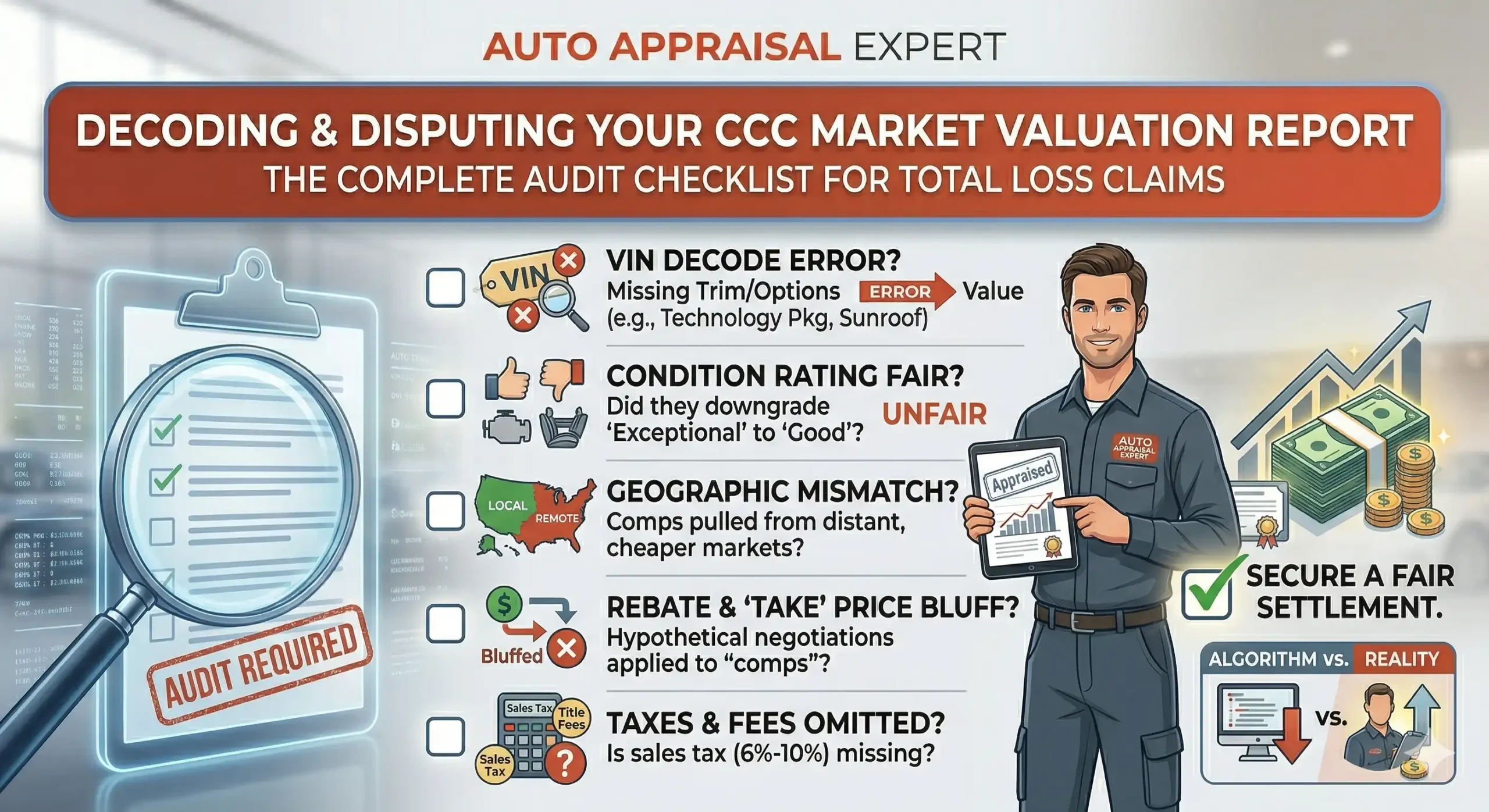
3. Five Major Flaws in CCC Reports (and How to Spot Them)
Through years of performing Total Loss Appraisals, our team has identified five systemic issues that frequently lead to undervalued claims.
A. The “VIN Decode” Failure
The CCC system uses your Vehicle Identification Number (VIN) to pull a list of standard features. However, VINs don’t always capture high-value “packages” or stand-alone options.
- What to check: Did they miss your upgraded sound system? Your panoramic sunroof? Your driver-assist technology?
- The Impact: Missing a single “Technology Package” can cost you $1,500–$3,000 in your final settlement.
B. The “Projected Sell Adjustment” (The Take Price)
This is perhaps the most controversial part of a CCC report. The software looks at a car listed at a dealership for $25,000 and applies a “Projected Sell Adjustment” (often 5–10%), claiming the dealer would have negotiated down to $23,000.
- The Error: In today’s “No-Haggle” and high-demand used car market, many dealers do not negotiate on price at all.
- The Fix: Challenge the adjuster to provide proof that those specific dealerships actually discounted those specific cars.
C. Subjective Condition Downgrades
The adjuster (who may have never even seen your car in person) assigns a condition rating. They often default to “Private Party” or “Good” condition.
- The Error: If your car was garage-kept, smoke-free, and detailed monthly, it should be rated as “Exceptional” or “Dealer Ready.”
- The Impact: Standardized deductions for “engine grease” or “interior wear” on a well-maintained car are arbitrary and should be removed.
D. Geographic Mismatch
Most state regulations require insurance companies to use “local” market data.
- The Error: CCC reports often pull comparables from 100 or 200 miles away. If you live in a high-cost urban area but the report pulls cars from a rural town where prices are lower, the valuation is skewed.
- The Fix: Insist that the comparables come from your specific zip code or immediate surrounding counties.
E. The Use of “Branded” or “Sold” Comps
Sometimes, the software pulls “comparables” that have a history of accidents themselves or are “salvage” titles.
- The Error: Comparing your one-owner, clean-title car to a car with a “rebuilt” title is an apples-to-oranges comparison.
- The Fix: Verify the VINs of the “comps” on the report. If they have a spotty history, they must be removed from the calculation.
4. How to Successfully Dispute the Offer
If your audit reveals errors, simply telling the adjuster “it feels low” won’t work. You need to follow a structured dispute process.
Step 1: Request the FULL Valuation Report
Never negotiate based on a single-page summary. You are entitled to the full CCC Market Valuation Report. If the adjuster hesitates, remind them that transparency is required in the claims process.
Step 2: Build Your Counter-Evidence
Go to retail sites like Autotrader and Cars.com. Search for your exact car (same year, trim, and similar mileage) within a 50-mile radius.
- Find at least 3 current listings.
- Save the PDFs or screenshots of these listings.
- If your car had recent major work (new tires, 100k-mile service), gather those receipts.
Step 3: Write a Formal Rejection Letter
Do not dispute the offer over the phone. Send a formal email or letter stating: “I am rejecting the settlement offer of [Amount] based on the following errors found in the CCC Market Valuation Report…” List your points (missing options, bad comps, etc.) clearly.
Step 4: Invoke the “Appraisal Clause”
This is your most powerful right. Almost every insurance policy contains an Appraisal Clause. If you and the insurer cannot agree on the value, you can hire your own independent appraiser.
- You hire an expert (like Auto Appraisal Expert).
- The insurance company hires an appraiser.
- The two experts negotiate to find a fair middle ground.
- If they can’t agree, a neutral “Umpire” makes a binding decision.
Note: Invoking this clause takes the decision away from the CCC algorithm and puts it into the hands of real-world automotive experts.
5. Why an Independent Appraisal is Essential
Insurance adjusters are trained to “stick to the system.” They will tell you, “The CCC report is the industry standard,” or “The software says the car is worth $X.”
An Independent Certified Appraisal breaks that cycle because:
- USPAP Compliance: Our reports are written to the highest professional standards, making them difficult for insurance companies to ignore in a legal or arbitration setting.
- Market Expertise: We don’t just use a database; we call local dealerships, look at actual auction “sold” data, and understand the nuances of specific vehicle markets (like the high demand for EVs or classic trucks).
- No Conflict of Interest: We work for you, the vehicle owner—not the insurance company.
6. Don’t Forget Sales Tax and Fees
In many states (such as Florida, Georgia, and others), the insurance company is legally required to pay you for the Tax, Title, and License (TT&L) associated with replacing your vehicle.
- If your car is worth $20,000 and your sales tax is 7%, the insurer owes you an additional **$1,400**.
- Many CCC reports hide this in the fine print or omit it entirely, hoping you won’t ask.
7. When to Call the Experts
Not every total loss claim requires a professional appraiser. If the offer is within $500 of what you expected, it may not be worth the fee. However, you should call Auto Appraisal Expert if:
- The gap between the offer and the market price is $1,000 or more.
- You drive a Luxury, Exotic, or Classic vehicle.
- The insurance company is ignoring your evidence of upgrades and maintenance.
- You have invoked the Appraisal Clause and need a professional to represent you.
Final Thoughts: You Are the Customer
The insurance company has a contract with you. That contract promises to indemnify you—to put you back in the financial position you were in before the loss. A flawed CCC report fails to meet that contractual obligation.
Don’t let an automated algorithm dictate the value of your hard-earned property. Take the time to audit the report, gather your evidence, and if necessary, bring in a professional advocate to ensure you get every dollar you deserve.
Contact Auto Appraisal Expert today for a consultation on your total loss claim. Let’s make sure your settlement is based on reality, not just software.
Quick Checklist for Your CCC Audit:
- [ ] Is the VIN decode correct? (Trim, Engine, Doors)
- [ ] Are all factory packages listed? (Tech, Premium, Sport)
- [ ] Is the mileage accurate?
- [ ] Are the “Comparables” actually in your local area?
- [ ] Did they subtract money for “Condition” unfairly?
- [ ] Is Sales Tax included in the final total?